Composition
Exact closure
One identity binds all six required members. An alias may improve display but cannot point to different bytes.
Prelaunch developer protocol
Discovery metadata for exact qualified SLM2 compositions, direct transfer between consenting peers, and an explicit local-conversion route when no matching peer is available.
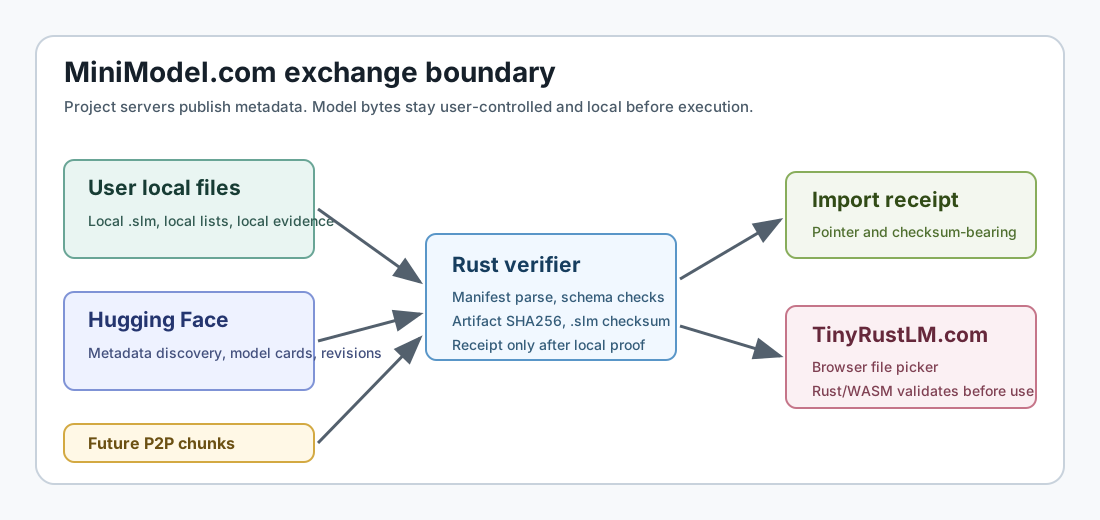
Current authority
MiniModel.org publishes bounded catalog and peer-announcement metadata. It does not host or proxy model bytes, run inference, perform server-side conversion, or certify model quality.
Fail-closed identity
A current catalog record binds exact public source and license provenance, the six-member SLM2 composition, member and piece digests, conversion and runtime profiles, qualification evidence, and an expiring peer announcement.
Composition
One identity binds all six required members. An alias may improve display but cannot point to different bytes.
Qualification
Structure, numerical parity, browser execution, behavior, peer availability, and publication remain distinct claims.
Peer offer
Consent, lane identity, piece set, endpoint, expiry, and protocol profile are explicit and independently checked.
Deterministic selection
The user sees which route is running. A failed peer route does not silently change peers, begin conversion, invoke remote inference, or download an instruction file.
Resolve one catalog identity and disclose storage, network, and runtime requirements.
Choose one exact qualified peer offer or one explicit pinned-source local conversion.
Check every piece, completed member, manifest binding, provenance, and qualification reference.
Atomically install only the complete accepted composition, then open it in TinyRustLM.com.
Network boundary
Companion API
The browser-to-companion protocol is origin-bound, authenticated, user-approved, expiring, and limited to typed acquisition operations. It accepts neither arbitrary filesystem paths nor unrestricted URLs.
Separate service boundary
MemoryEndpoints.com is authorized, but it is not a MiniModel model-byte transport, catalog, peer relay, or inference service.
Use 1
Agents working across all maintained ecosystem sites use MemoryEndpoints.com directly for agent-to-agent long-term memory, meetings, handoffs, and coordination.
Use 2
Separately, a user signs in to MemoryEndpoints.com and explicitly selects it as TinyRustLM.com Connect long-term memory.
The two lanes keep identity, credentials, consent, scopes, provenance, idempotency, and receipts separate. Prelaunch memory may also be duplicated in current `.uai`, wiki, public-safe source notes, and approved private stores when every maintained copy remains current, secret-safe, provenance-labeled, and noncontradictory.
Truthful prelaunch status
Configuration, fixtures, local probes, mocks, a catalog row, or a reachable endpoint do not prove qualification, public P2P availability, a live MemoryEndpoints operation, browser activation, deployment, or publication.
| Evidence class | Current count | Required authority |
|---|---|---|
| Qualified models | 0/20 | Exact qualification receipt |
| Clean browser rounds | 0/50 | Real fresh-profile browser receipt |
| Live memory rounds | 0/25 | Exact authorized hosted-memory receipt |
| Externally proven P2P lanes | 0/40 | Outside-network sender and receiver evidence |
| Catalog announcements | 0/20 | Exact public publication and readback receipt |
Evidence and claim rules Current site release Publication history